The Random Comic Strip

The Random Comic Strip

Words to live by...

"How beautiful it is to do nothing, and to rest afterward."

[Spanish Proverb]

Ius luxuriae publice datum est

(The right to looseness has been officially given)

"Everyone carries a part of society on his shoulders," wrote Ludwig von Mises, "no one is relieved of his share of responsibility by others. And no one can find a safe way for himself if society is sweeping towards destruction. Therefore everyone, in his own interest, must thrust himself vigorously into the intellectual battle."

Apparently, the crossword puzzle that disappeared from the blog, came back.


Tuesday, October 6, 2009

The Invisible Man

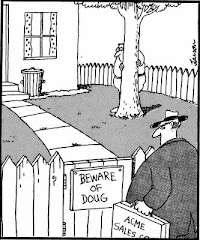
I have a superpower. I can become invisible. Less so than I did when I was young but I can still do it. The problem is that I could never control it.

Before you start thinking "Douglas has consumed a bit too many adult beverages", let me explain about this superpower.

I first noticed it when I was in my teens. I would walk into a dance, or a party, or a classroom and no one would notice. I'd walk down the hall at school and have to dodge people constantly, even those looking directly at me as they walked. It wasn't all the time, of course, just randomly. I know what you are thinking, that this happens to all of us from time to time. Other people are simply involved with other things and don't notice you. I thought so, too. For awhile. I also thought I just tended to blend in with the background. So average, so bland.

In the Navy, it was understandable. Most of the time, you are entirely un-unique. Large groups of people are dressed the same, few stand out. And, when they do, it's because of size, rank, or trappings. There is a reason for all the gold braid, the flags on cars, maybe even the shiny buttons on the officers' uniforms. Among the enlisted, there is virtually no difference. You are simply a drop in the ocean.

But I began to notice it when I was in civilian clothes and later when I was a civilian. I still thought I was just blending in. Or being deliberately ignored because I was scruffy, bearded, and long haired.

It was at restaurants that I began to realize what was really happening. Being not exactly overflowing with money, I patronized cafes and chain restaurants. You are rarely seated at these places, you just pick a table and sit. A waitress or waiter drops by and hands you a menu, maybe along with a glass of water. Not for me. More often than not, I would be sitting for a long stretch of time before an approach by any staff. And something would happen in my vicinity just preceding it. Something to draw attention toward where I was sitting.

Sometimes, I would have to make that something happen. I would stop a waitress walking by on her way to attend to someone else, someone who had sat down only minutes before (and several minutes after I had). There would be a look of shock in her eyes, more often than not, and a quickly mumbled "Oh, I didn't see you there, I'll be right back."

It was then I realized I was invisible at times. I began to notice it in stores while waiting for someone to ask me what I want, or take my payment for an item, or help me find something.

The most memorable incident happened in Columbus, Ohio. In a bar called The Wharf. An odd name for a bar in the middle of a mid-western state, far from any ocean, even far from the only large body of water, a Great Lake... but I digress.

I was to meet a couple of friends there and we were headed to somewhere to eat and drink. We were students at a training facility for telephone companies in nearby Dublin. I came into the place and found my friends at the far side of the horseshoe shaped bar. It was not crowded but far from empty. I took an empty seat to the left of Rick and waited for the barmaid to ask me what I wanted. Rick seemed not to notice I had come in but he was deep in conversation with Bob on his right so I didn't think anything of it. It was only when the barmaid came over and asked Rick if he wanted a refill and then asked Bob if he did and ignored me looking right at her that I realized what had happened.

I had become invisible. Still, I wasn't sure. I waited, I even spoke, she passed by a couple more times, even looked my way but through me, if you know what I mean. I decided I needed to take some action or I would remain invisible. I pushed the plastic ashtray gently toward the inside edge of the bar, toward the area in te middle of the horseshoe shape. Toward the ice machine just a foot or so below the bar surface. I did it slowly so I could stop it if she noticed me.

She didn't. She was passing by again and was just a few feet away, her back turned toward me when the ashtray hit the metal panel of the ice machine and made a rather loud noise. She jumped about a foot in the air and spun around.

I was visible again. She spotted me and said, "Did you do that to get my attention?"

"It seems to have worked," I replied. "Could I have a draft, please?"

Monday, October 5, 2009

Science and the American Public

I'd like to talk about science. A fellow blogger notified me of a C-SPAN Book TV show of interest. He does this on a regular basis. We don't agree on many things but we seem to share a lot of interests.

Anyway, he sent me this link and the time of the show (last evening at 10 PM EDT)...

http://www.booktv.org/Program/10690/Unscientific+America+How+Scientific+Illiteracy+Threatens+Our+Future.aspx

While I was watching, the author spoke of a disparity he found (though he kept saying "we", it wasn't clear who "we" were) in the American public's understanding, and acceptance, of science. One of the things he mentioned was the influence of religion in that disparity.

He brought up the debate between creationism and evolution as an example. Now, you must realize that most scientists and virtually all those involved in the science of biology and anthropology accept evolution as an absolute. And probably the majority of us accept it without any deep consideration about what it means to those who have strong religious beliefs.

Personally, I cannot understand why it is such a contentious issue. Not because I believe it is a reasonable explanation of how modern man came about but because I do not see how it impacts anything of importance in daily life.

It seems to me that, if you are strongly religious and your religion rejects the theory of evolution, you aren't likely to end up in any scientific field which depends on it as a foundation.

If you are an average person, the debate has no real impact on your life. Whatever you believe to be the origin of man, you can still be a mechanic, a salesman, a secretary, a nurse, even a doctor or nuclear physicist.

So why was that important to the author (and the collective "we" of which he claimed to be spokesman) in explaining the disparity he was concerned with?

I have known many strongly religious people who totally rejected evolution but had no problem with understanding science and who even used the scientific method in their work. Just because they rejected evolution it didn't mean they rejected all the advances that science has made.

Why would it?

Saturday, October 3, 2009

First Saturday of October


Today was not a normal Saturday. You see, I played in a scramble today. Now, for those of who do not know much about golf, a scramble is a game where all players in a team play their next shot on each hole from the position of the best previous shot made by a member of their team. Teams are usually foursomes, or 4 people (or whatever it is one calls golfers).

The occasion was the grand re-opening of the local municipal golf course. This is my home course. It underwent an overhaul of all the greens and many of the tee boxes, a project which took many months. And had mixed results. This is a municipal course, after all, and that means it is run by the city. So it is not going to be country club quality. Still, it was in pretty good shape overall.

Now these events involve a bit of honesty. Teams are divided into groups, called flights, based upon the ability level of the teams. Teams with better players (based usually on a total of the team's handicap) are placed in the "A" flight and there is usually a "B" flight and sometimes a "C" flight. And here is where the honesty comes in. The players tell the match's organizers what their handicaps are. No one checks, no one confirms. This can lead to some "fudging" of the handicaps.

A handicap represents the number of strokes a player, on average, records over par. Par being 72, a player with a handicap of 15 averages 87 strokes a round. There is some calculation of other factors (most notably the severity ranking of the course) that goes into it but, in general, that's what it means. Most handicaps are liquid. That is, they change over time. You get better, you get worse, you get into slumps, you have streaks of great play, etc.

Theoretically, however, handicaps allow the poorest player to compete with the best. In reality, that's just theory. A good player will beat a poor player way more often than theory suggests.

Most golfers claim handicaps in casual conversation that are lower than their actual ability might merit. It's a bragging rights thing. However, the reverse happens when it comes to reporting said handicap when entering a tournament. A practice often referred to as sandbagging. I have no idea how that term came about.

That wasn't a big issue today. We had only two flights and I never did find out the criteria for each. And our team was remarkably honest in reporting our handicaps. With two flights, and a wide range of ability levels, things tend to even out overall. We ended up in the "A" flight.

We did not win, however. We did not even place third. Still, our score was 10 under par or 6, only 4 shots worse than the winning team's score of 58. And that was good enough to tie for 4th which got us exactly nothing in prizes. We felt we had done as well as we could.

That, in the end, is all that matters. Well, and having a good time with friends.

Which we did.

[1848/1849/1718]

Friday, October 2, 2009

BouncingThoughts

I'm going to bounce around a little today because... well, because my brain is bouncing around a little anyway.

I had a few thoughts hit me the other night. Each was worthy of an entire blog but none needed that much.

Here's those thoughts...

I have decided that Mother Teresa was an egotist. Don't get me wrong, she did wonderful things and was worthy of all the praise she garnered. But I believe her greatest works were done in obscurity. Once fame adheres to a person, it takes control and the works take second place behind the celebrity. Once you are renowned as a great humanitarian, you can offer simple platitudes and it is taken as profound wisdom. But what courage and self-sacrifice at the beginning! The greatest deeds are done when no one is watching.

On a similar note, I suspect that activists are extremely egotistical. Especially those that advocate for peace, or the environment, or for whatever various political or social causes they target. They want to convince you to think like they do. They believe in the rightness of their perspective to the exclusion of opposing views. And they want you to also believe that. This is never good, not matter the worthiness of the cause. They might compromise on detail temporarily but eventually, the ego will win out. And the cause will become less important than the spokesperson. In fact, the cause may start as secondary to such a person.


There is one thing, one invention of man, that has bothered me most of my life. The bow and arrow. I could understand most other tools evolving from nature. The spear, the sword, the hammer, the knife, the lever, even the wheel. But the bow itself is amazing. It does not actually exist in nature. Not in a form by which it acts in the weapon. A branch may bow and show energy stored. But the transference of that energy into the string? No, that's not readily apparent. And virtually all cultures developed the bow and arrow in almost the same form (though not all continued its use). The bow and arrow appears to be at least 60,000 years old. That is based on the finding of flint arrow heads in Africa dating back that far. Primitive knives and spears are undoubtedly older. And the arrow itself is easily a modification of a spear. But the bow... a piece of wood, bent to store power to be transferred to a string, which would then transfer it to the launch of a mini-spear. Ingenious! True abstract thought.

Thursday, October 1, 2009

Whew!


I am exhausted, pooped, worn out, dragging my behind, yadda yadda. To the left is the route I took home from Biloxi. It is 9 hours of driving. It would have been longer if I had taken a more scenic route than interstates. But, let's face it, the interstates are so tempting. No traffic lights, no annoying cross streets, no pesky 35 MPH speed limits. Just clear sailing at 70 MPH (effective speed is 75 MPH) all the way. If I had taken the more scenic route, I'd have stopped for an overnight stay at some seedy motel (since the nice ones are all near an interstate) because it would have taken closer to 14 hours to make the trip. So I took the easy way out. And paid the price. When I was much younger I took the trip in the opposite direction and on the more scenic highways and byways. I left from a little further south and at 4 in the afternoon. I arrived in Pensacola sometime around 8 AM, stopping only once for coffee near Tallahassee and finally getting on the interstate (I-10). I left Pensacola after an oil change and breakfast and didn't stop until I reached Deming, NM the next morning around 1 AM.

There are things you can do at age 24 and alone that are unheard of at 63 with a wife in the car.